
IAB Roundtable Urges Preparedness Over Panic as Bangladesh Faces Growing Earthquake Risks

Published : 19:44, 5 December 2025
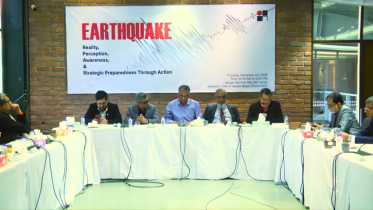
The Institute of Architects Bangladesh (IAB) held a high-level roundtable discussion titled "Earthquake: Reality, Perception, Awareness & Strategic Preparedness through Action" at the IAB Centre in Agargaon, Dhaka.
The event brought together leading experts to address Bangladesh's earthquake vulnerability following recent seismic activities.
Bangladesh recently experienced several earthquakes, including a devastating 5.7-magnitude quake on 21 November near Madhabdi, Narsingdi, which killed 10 people and injured over 600. Between 2021 and 2024, 39 earthquakes occurred inside Bangladesh, with 11 near Dhaka, underscoring the capital's vulnerability.
To discuss these concerns, the roundtable brought together key national leaders. The architecture community was represented by senior IAB Fellows, including renowned architect and urban planner Iqbal Habib; former IAB President and former Chief Architect of the Department of Architecture Kazi Golam Nasir; current Chief Architect Asifur Rahman Bhuiyan; former BUET Architecture Professor and former Vice-Chancellor of Leading University, Architect Professor Dr Qazi Azizul Mowla; and BUET Architecture Assistant Professor, Architect Patrick D' Rozario.
Engineering expertise came from distinguished civil engineer Professor Dr Shamim Z Bosunia, former BUET professor and member of the Padma Bridge Expert Panel; BUET Civil Engineering Professor Dr Raquib Ahsan; Bangladesh Association of Structural Engineers Convener Abdullah Al Hossain Chowdhury; and Public Works Department Supervising Engineer Shakhawat Hossen.
Urban planning and government perspectives were provided by RAJUK Chief Urban Planner (current charge), Md. Ashraful Islam, Housing and Building Research Institute (HBRI) Director General Dr Mohammad Giyasuddin Haydar, Dhaka University Geology Department Chairman Professor Dr Badruddoza Miah; Disaster Management and Relief Ministry Joint Secretary Golam Mostafa; and Fire Service and Civil Defence Director (Operations) Lieutenant Colonel Mohammad Tajul Islam Chowdhury.
The session was chaired by IAB President Architect Professor Dr Abu Sayed M Ahmed, with IAB Vice President (National Affairs) Architect Nowajish Mahbub moderating the discussion. IAB General Secretary Architect Dr Masud Ur Rashid delivered the welcome address.
Professor Dr Shamim Z Bosunia stated that proper structural engineering supervision and compliance can ensure safety. "If those who are skilled and experienced in structural engineering do their work properly, and if supervision during building construction is done correctly, then I think there is no reason to be afraid.
Trust in Allah. Inshallah, there will be no major damage. When an earthquake occurs, do not rush down the stairs; take shelter in a safe area. Stay alert without losing your senses. Many lives can be saved through such precautions alone."
Architect and urban planner Iqbal Habib highlighted that while earthquakes cannot be prevented, damage can be minimised. He expressed concern over the lack of monitoring in building approval processes and stressed the urgent need for regulatory authority formation, block development, and TDR implementation to reduce risks from fire hazards, gas leakage, and faulty construction.
Professor Dr Raquib Ahsan from BUET's Civil Engineering Department noted that not all civil engineers are skilled in earthquake-resistant design. He called for continuous professional development and training, emphasising the need for architects and engineers to work collaboratively on building safety.
Former IAB President and former Chief Architect Kazi Golam Nasir cautioned against spreading panic through unscientific earthquake predictions. "Instead of fear, we need immediate action: identify vulnerable buildings, widen narrow roads for emergency access, retrofit critical government infrastructure, including hospitals and the Secretariat, secure free-standing furniture to walls, ensure proper soil testing for new construction with skilled professionals, and clearly mark emergency exits."
IAB President M Sayed Ahmed emphasised the institute's commitment to protecting the nation: "If we work on post-disaster planning, we can recommend many things to the government. We want to save the country and protect everything in it; we want to survive together."
The roundtable revealed critical gaps in Dhaka's disaster response capacity, with only 17 fire stations serving over 30 million people. Experts unanimously called for urgent action, including building retrofitting, improved building codes, community earthquake drills, and integration of disaster management into school curricula.
The roundtable concluded with participants committing to forward recommendations to policymakers. Experts unanimously called for dispelling earthquake-related misconceptions and building realistic, evidence-based preparedness strategies to safeguard lives and minimise losses in Bangladesh's most vulnerable areas.
BD/AN
Subject-