
Myanmar Begins Defence in Landmark Genocide Case at UN’s Top Court
Published : 00:08, 18 January 2026
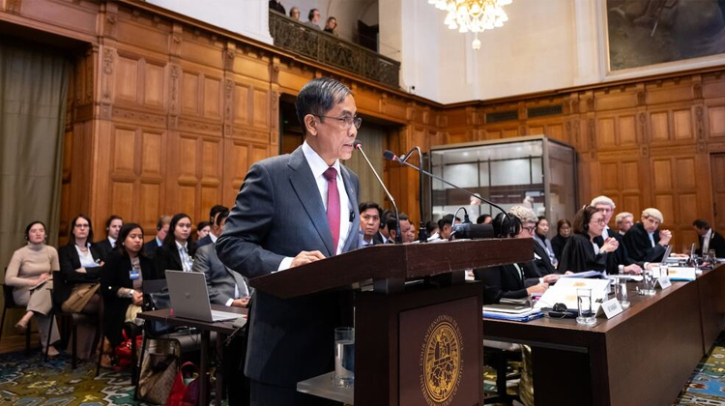
Myanmar has formally begun presenting its defence at the International Court of Justice in a landmark case accusing the country of committing genocide against the Rohingya Muslim minority, marking a critical phase in one of the most consequential international legal proceedings in recent years.
The case was brought by Gambia, acting on behalf of the Organisation of Islamic Cooperation, which accuses Myanmar of violating the Genocide Convention through its military operations in Rakhine State. Those operations in 2016 and 2017 forced more than 700,000 Rohingya to flee to neighbouring Bangladesh, where they remain in refugee camps.
In its defence, Myanmar rejected allegations of genocide, arguing that its security forces were responding to attacks by insurgents and that any abuses committed did not demonstrate genocidal intent.
Government representatives told the court that allegations of mass killings, sexual violence, and village burnings had been exaggerated or mischaracterised, and that Myanmar’s domestic legal system was capable of addressing any wrongdoing.
Myanmar also challenged the jurisdiction of the court and the legal standing of Gambia to bring the case, contending that the dispute does not fall within the scope of the Genocide Convention as interpreted by the defence. Lawyers for Myanmar said the country has cooperated with international mechanisms and taken steps toward accountability.
The case has drawn global attention as a rare instance in which a state is being tried at the UN court over alleged genocide while the accused actions are relatively recent.
Human rights organisations argue that the proceedings are vital for justice for the Rohingya, who have long faced discrimination, denial of citizenship, and severe restrictions on movement and access to services.
The ICJ has already ordered provisional measures requiring Myanmar to take steps to prevent acts of genocide and preserve evidence. The court’s current hearings focus on preliminary objections, and a final ruling on the merits of the case is still expected to take years.
The outcome is seen as a major test of international law and accountability, with implications not only for Myanmar but also for how genocide cases are pursued at the global level.
Sources: Reuters, BBC News, Al Jazeera, United Nations International Court of Justice
BD/AN