
Public Suffering on the 100-Foot Road: Who Will Take Responsibility?
Published : 16:50, 19 October 2026
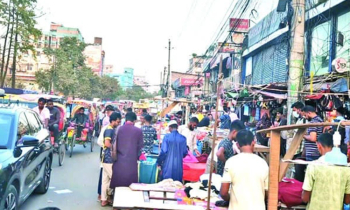
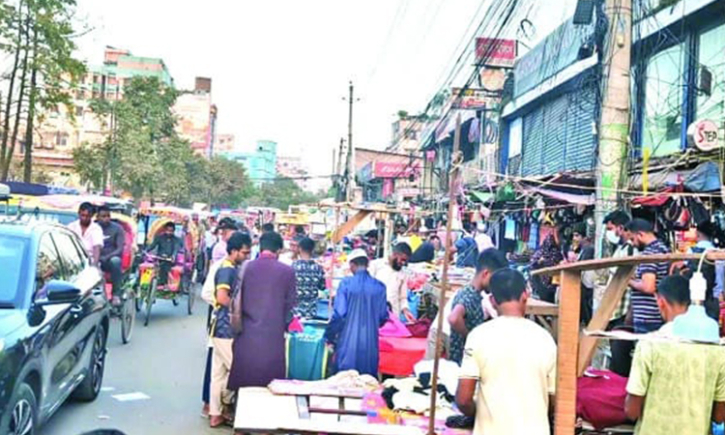
The 100-Foot Road on Madani Avenue, under Bhatara Police Station in the capital, is 100 feet wide in name only. In some places, just 10 feet remain available for vehicular movement. Temporary shops line both sides of the road, auto-rickshaws are parked in rows on one side, and private cars are parked indiscriminately on the other. As a result, a significant portion of this busy road is effectively occupied. Yet, residents say, there appears to be no one to address the situation.
Local residents have long complained about road encroachment, illegal parking and auto-rickshaw stands. Pedestrians face difficulties, vehicles form long queues, and the risk of accidents remains constant. Although images of road encroachment have surfaced on various occasions, the situation has not changed permanently. Questions are being raised about why the relevant authorities have failed to take effective action despite shops operating and vehicles being parked on occupied portions of the road in full public view.
A visit to the area revealed that temporary shops have been set up in three to four rows, extending beyond the footpath onto the main road. In some places, goods are displayed on the road, while in others, shop equipment occupies a substantial portion of the space. Auto-rickshaws are lined up along one side of the road. Private cars and other vehicles parked at various points further reduce the space available for traffic.
According to local residents, nearly 90 feet of the 100-foot-wide road is occupied in one way or another. Consequently, in some places, only 10 feet remain available for vehicles to pass. Despite the road's considerable width, motorists are forced to use narrow stretches. Even a slight increase in traffic quickly leads to congestion.
Pedestrians are among those suffering the most from the situation. With the footpaths occupied, they are forced to walk on the main road. Motorcycles, private cars and other vehicles move past them at speed, creating the risk of accidents at any moment. Women, children and elderly people face even greater risks. The situation becomes more dangerous in the evening and at night as pedestrian movement increases.
Traffic congestion has also become a daily feature of the road. Local residents complain that there is no relief in the morning, at noon, in the afternoon or in the evening. One section of the road is occupied by street vendors, while another is taken up by auto-rickshaw stands and illegal parking. As a result, vehicles cannot move at a normal speed, and commuters have to spend additional time covering even short distances.
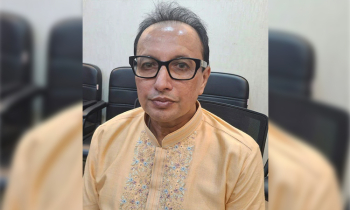
Md. Siraj Mia, a resident of the area adjacent to the 100-Foot Road, said, “The difficulties people face while walking because of the occupied footpaths have become an everyday problem. There is congestion at all times—morning, evening, afternoon and noon—because of the footpaths and the illegal auto-rickshaw stand.”
Local residents question where the relevant authorities' oversight is when such a large portion of an important road remains occupied. They also ask how businesses can continue operating on the footpaths and road for days, how auto-rickshaws can remain parked along the roadside, and how indiscriminate parking is allowed to continue. They believe such a situation should not persist for so long if regular monitoring and enforcement of the law are in place.
Questions have also arisen over whether a lack of coordination among the agencies responsible for clearing road encroachments is contributing to the problem. Effective action is needed both in traffic management and in removing illegal occupations. A lasting solution will not be possible through traffic control alone unless the occupied portions of the road are cleared. Similarly, if regular monitoring does not follow an eviction drive, there is a risk that the encroachment will return.
Regarding the issue, Deputy Commissioner (DC) Md. Tarek Zubayer of the DMP Traffic Gulshan Division said the occupation of the 100-Foot Road by various shops was under their monitoring. As everyone was occupied with security arrangements for the Durga Puja festivities, it was not possible to take action on the matter immediately. After the Puja, a mobile court would be conducted in coordination with the Crime Division to clear the entire road of encroachments, he said.
Local residents, however, expect the eviction drive to go beyond assurances. They want the road cleared of street vendors, illegal parking and auto-rickshaw stands to ensure the normal movement of pedestrians and vehicles. They also call for regular monitoring to prevent the road from being occupied again.
If nearly 90 feet of a 100-foot road is occupied, who is responsible for clearing it? How much longer must the public wait to regain space intended for their movement? Local residents continue to ask: Is there no one who can free the road from encroachment?