
Tk 9.38 Trillion Budget Targets Inflation Control, Investment, and Job Creation

Published : 20:01, 12 June 2026
Finance Minister Amir Khasru Mahmud Chowdhury has proposed a Tk 9.38 trillion national budget for the 2026–27 fiscal year, focusing on easing inflationary pressures, boosting investment and employment, expanding social safety net programs, and promoting a more productive and decentralized economy.
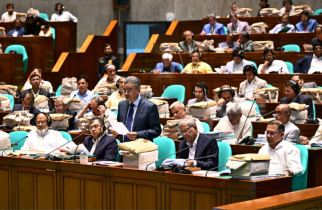
Presented in Parliament on Thursday, the proposed budget is the largest in Bangladesh’s history, equivalent to 13.7 percent of the country's Gross Domestic Product (GDP). The budget size has increased by Tk 1.48 trillion compared to the previous fiscal year.
The budget has been prepared under the theme, “Economic Democratization and Decentralization: Bangladesh on the Path to a Trillion-Dollar Economy.” It is also the first national budget of the government led by Prime Minister Tarique Rahman.
In his budget speech, the finance minister said the proposal was formulated considering both domestic economic challenges and global uncertainties, with priorities placed on stability, investment, production, employment, and economic fairness.
The government has set a target of reducing inflation to 7.5 percent in the coming fiscal year. Accelerating economic growth, increasing investment, and generating employment opportunities have also been identified as key policy objectives.
Special emphasis has been placed on increasing agricultural production, improving supply chains, strengthening market management, and expanding social protection programs for low-income groups. Tax and duty exemptions on essential medical supplies and several daily necessities have also been proposed to help reduce consumers’ living costs.
To improve the investment climate, the government plans to simplify business procedures, expand digital services, streamline licensing and approval processes, and introduce a more business-friendly tax structure. These measures are expected to encourage both domestic and foreign investment and create new employment opportunities.
The total revenue collection target has been set at Tk 6.95 trillion, including Tk 6.04 trillion from the National Board of Revenue and Tk 910 billion from other sources.
Development expenditure has been proposed at Tk 3.16 trillion, including Tk 3 trillion under the Annual Development Programme (ADP). Priority sectors include healthcare, education, and human resource development.
The budget also introduces new social protection initiatives, including Family Cards and Farmer Cards, aimed at supporting low-income and marginalized communities.
The overall budget deficit is estimated at Tk 2.43 trillion, equivalent to 3.6 percent of GDP, with financing planned through both domestic and foreign sources.
Concluding his speech, the finance minister called for the cooperation of farmers, workers, entrepreneurs, students, women, youth, professionals, and expatriates, saying that the creativity and initiative of the people remain Bangladesh’s greatest asset in achieving a prosperous, self-reliant, and dignified future.
Subject-