
Alleged Tk 30 Billion Annual Extortion from Dhaka Footpaths Spurs Calls for Action Against Illegal Occupation
Published : 17:58, 30 October 2026
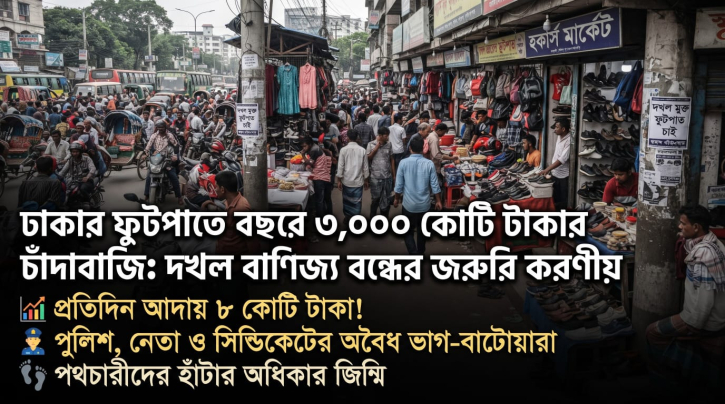
A powerful syndicate is allegedly controlling parts of Dhaka’s footpaths and collecting money from street vendors, with the annual volume of extortion reportedly reaching around Tk 30 billion. The allegations have renewed calls for an investigation and sustainable measures to end illegal occupation and ensure safe pedestrian movement.
According to figures attributed to the Bangladesh Hawkers Federation, Dhaka North and South have around 270,000 hawkers, with the number reportedly rising to approximately 320,000 during Eid. If each vendor pays an average of Tk 300 a day, daily collections could exceed Tk 80 million. Based on this estimate, the annual amount could reach several billion taka.
A previous estimate by the BRAC Institute of Governance and Development (BIGD) reportedly put annual footpath-related extortion at Tk 18.25 billion. Stakeholders claim that the figure may have increased to around Tk 30 billion due to the growth in the number of vendors and the scale of collections. The estimates, however, require independent verification.
Footpath occupation and alleged extortion have been reported in several busy areas of the capital, including Gulistan, New Market, Baitul Mukarram, Paltan, Motijheel, Dainik Bangla intersection, Golap Shah Mazar, Zero Point, Bangabandhu Avenue and Fulbaria.
According to the allegations, vendors are charged between Tk 200 and Tk 300 a day, while the amount may range from Tk 100 to Tk 1,500 depending on the size and type of business. Additional collections are reportedly made for electricity, including a Tk 100 charge for a light bulb, as well as payments described as security fees.
The allegations further suggest that collected money is distributed among police personnel, local controllers or “line-men,” and politically influential individuals. One reported breakdown puts the shares at 30 percent for police, 40 percent for controllers and 30 percent for local political leaders. These claims require impartial investigation before any conclusions can be drawn.
Police and city corporation officials have generally denied involvement in such activities and have said they would take action if specific evidence is provided. Despite periodic eviction drives, however, footpath occupation reportedly returns after a short period, disrupting pedestrian movement and contributing to traffic congestion.
Measures Needed to End Footpath Occupation and Extortion
Urban experts and stakeholders say eviction drives alone cannot provide a lasting solution. A coordinated and sustainable approach is needed.
First, authorities should introduce a system for registering hawkers, issuing identification cards and maintaining a reliable database. Vendors could be allowed to operate in designated areas through an official licensing system, with payments made directly to the authorities to reduce opportunities for informal extortion.
Second, allegations of extortion involving syndicates, line-men, officials or influential individuals should be investigated. Anyone found responsible should face appropriate action based on evidence. An effective mechanism for receiving and investigating complaints is also essential.
Third, authorities could introduce designated vending zones, time-based trading arrangements and alternative hawker markets. Such measures could help protect vendors’ livelihoods while ensuring that pedestrians can use footpaths safely.
Fourth, city corporations, law enforcement agencies, citizen representatives and hawker associations should work together to establish independent monitoring and accountability mechanisms. Regular supervision and consistent enforcement would be necessary to prevent renewed occupation.
Footpaths are primarily intended for pedestrians. Stakeholders say authorities must balance the livelihoods of hawkers with the public’s right to safe and unobstructed movement. A transparent, coordinated and sustained effort by the administration and city corporations is considered essential to address the long-standing problem of illegal occupation and alleged extortion.