
Amir Khasru Mahmud Chowdhury: BNP will review the NEIR policy

Published : 19:09, 7 December 2025
BNP Standing Committee Member Amir Khasru Mahmud Chowdhury has said that the party will certainly review the NEIR (National Equipment Identity Register) policy if it assumes office. Any policy changes will be made in consultation with all relevant stakeholders.
He also stated that any policies enacted by the former Awami League or the current government that contradict the principles of a free-market economy will be reassessed.
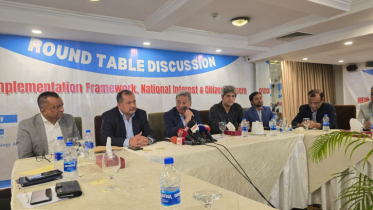
He made these remarks on Sunday at a roundtable discussion titled “NEIR: Implementation Framework, National Interest, and Citizen Concerns,” organized by the Center for Technology Journalism (CTJ) at Hotel Sarina in the capital.
Khasru said, “Why should essential products cost more? The government claims to have invested Tk 67,000 crore in ‘Digital Bangladesh’; what has been the outcome? Locally, those assembling mobile phones in the name of production are taking advantage of policy preferences, but how much value are they truly adding? We must assess whether those investing in the sector are generating increased value addition every year.
We also need to determine whether the tax burden is balanced for both parties. If a policy is designed to benefit a particular syndicate, that business model cannot be sustainable.”
He further warned that creating opportunities for monopoly businesses would enable them to dominate and control all other entrepreneurs. “Already, those assembling devices domestically enjoy nearly 50% preferential benefits. If other businesses are forced out and a single group gains exclusive control, the outcome will not be favorable,” he added.
CTJ President and Assistant Editor of Daily Samakal, Hasan Jakir, presented the keynote at the roundtable.
BNP Chairperson’s Advisor Zahir Uddin Swapon said that any policy must first and foremost serve the interests of the state and its people. He emphasized the need to assess whether a policy truly benefits the public or merely serves a specific syndicate. “Policies cannot be formulated to enrich particular individuals,” he said.
Ganasanghati Andolon’s Chief Coordinator Zonayed Saki stated that at a time when employment opportunities are scarce in the country, the NEIR policy is putting at risk those who have created jobs in this sector.
“Taking unilateral decisions without consulting stakeholders or following democratic procedures surpasses even the practices of previous authoritarian regimes. Policies like those pursued under Sheikh Hasina are dangerous and deeply concerning.
No government can adopt such one-sided policies, especially when facing potential political upheaval. Policies must support small and medium enterprises and ensure they can continue to operate,” he added.
Other participants at the roundtable included Faisal Alim, Secretary of the Bangladesh Association of Contact Center & Outsourcing (BACCO); Aminul Hakim, President of the Internet Service Providers Association of Bangladesh (ISPAB); Rafael Kabir, former Chairman of BASIS’s Supportive Committee; Md. Sayem Faruqi, Editor and Publisher of Daily Rupali Bangladesh; Abbas Uddin Nayon, Chief Reporter of The Business Standard; Mohiuddin Ahmed, President of the Bangladesh Mobile Phone Consumers Association; Mohammad Arifur Rahman, President of the Chattogram Metropolitan Mobile Traders Association, among others.
Guest Remarks
Amir Khasru Mahmud Chowdhury
Member, BNP Standing Committee
He stated that a BNP-led government would undoubtedly review the NEIR policy. Any revisions would be made in consultation with all relevant stakeholders. Policies introduced by the former Awami League government or the current administration that contradict the principles of a free-market economy would be reassessed.
He questioned why essential goods should be priced so high and asked what tangible benefits had resulted from the government’s Tk 67,000 crore investment in “Digital Bangladesh.” He also noted that those assembling mobile phones locally under the banner of “production” are taking advantage of policy support, yet their actual value addition remains questionable.
According to him, it must be examined whether investors are increasing value addition year over year, and whether the tax burden between different parties is fairly balanced. If a policy is designed to benefit a particular syndicate, such a business model cannot sustain itself.
Granting monopolistic opportunities would allow certain groups to dominate and control the entire sector. He warned that local assemblers already enjoy nearly 50% preferential benefit, and if other businesses are forced out, the consequences of a single group gaining complete market control would be damaging.
Zahir Uddin Swapon
Advisor to the BNP Chairperson
He stressed that any policy must first serve the interests of the state and its people. It must be examined whether
BD/AN