
Institutional Democracy and Political Stability Are Essential for Bangladesh’s Progress
Published : 02:38, 3 August 2026
Following the national election, Bangladesh's foremost priorities include maintaining political stability, accelerating economic growth, strengthening good governance, and advancing ongoing reform initiatives. Achieving these goals requires responsible engagement from the government, opposition parties, state institutions, and civil society alike.
In any democratic system, differences of opinion between the government and the opposition are both natural and necessary. Constructive criticism of public policies and government performance is an essential component of democratic accountability. At the same time, political competition should always remain within the framework of the Constitution, the rule of law, and democratic institutions.
At present, citizens are primarily concerned with issues such as inflation, employment opportunities, quality education, healthcare, investment, and efficient public services. Political discourse will be more meaningful when it focuses on practical policy solutions that address these everyday challenges.
A healthy democracy is measured not only by elections but also by the strength of its institutions, effective parliamentary debate, freedom of expression, the rule of law, and public accountability. Responsible political conduct and mutual respect among stakeholders contribute significantly to democratic resilience.
Political parties also have a responsibility to uphold internal discipline, ethical standards, and transparency. Whenever allegations arise, they should be addressed through due legal process, impartial investigation, and accountability. Such practices strengthen public confidence in democratic institutions.
Similarly, dialogue, tolerance, and mutual respect should guide political engagement in educational institutions and throughout society. Differences of opinion are a natural feature of democracy, but they should never become a source of unnecessary division or instability.
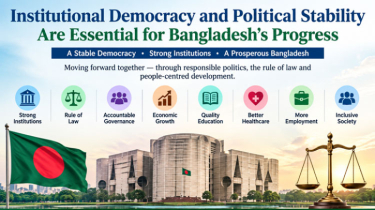
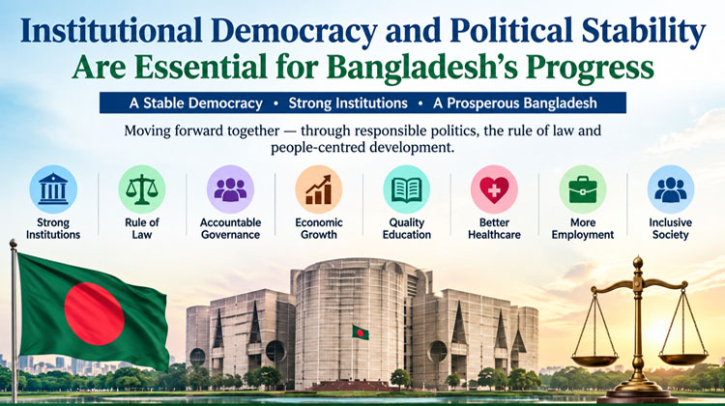
Bangladesh is at an important stage of national development and institutional transformation. In this context, political stability, policy-driven competition, and strong democratic institutions are essential for sustaining long-term economic and social progress. Both the government and the opposition have a shared responsibility to respect constitutional principles and contribute to a mature democratic culture.
The foundation of a sustainable democracy is not political confrontation but responsible leadership, constitutional continuity, the rule of law, accountability, and public trust. Strengthening institutional democracy remains one of the most important prerequisites for building a stable, inclusive, and prosperous Bangladesh.
MDH