
Grave Space in Dhaka Now Costs Crores: Banani Cemetery Charges Tk 4.5 Crore for 25-Year Preservation
Published : 10:53, 28 September 2026
In Dhaka, where the cost of a house, flat, or even a small piece of land can consume years of savings, securing a grave for long-term preservation after death has also become a major financial consideration for many families.
While the official registration fee for an ordinary burial is only Tk 500, preserving a grave for an extended period can cost lakhs or even crores of taka. At Banani Cemetery, preserving a grave of around 20 square feet for 25 years costs approximately Tk 4.5 crore.
The growing shortage of land, increasing pressure for burials, and rapid urbanisation have made space increasingly scarce in Dhaka’s cemeteries.
Just as land prices for residential purposes continue to rise, the value of a few feet of land as a final resting place has also become increasingly significant. While an ordinary burial at some cemeteries can be completed for several hundred to around Tk 1,500, long-term preservation involves substantially higher costs.
In some cemeteries, the cost is several lakhs or tens of lakhs of taka, while in areas such as Banani, it has reached several crores.
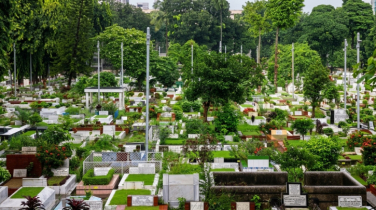
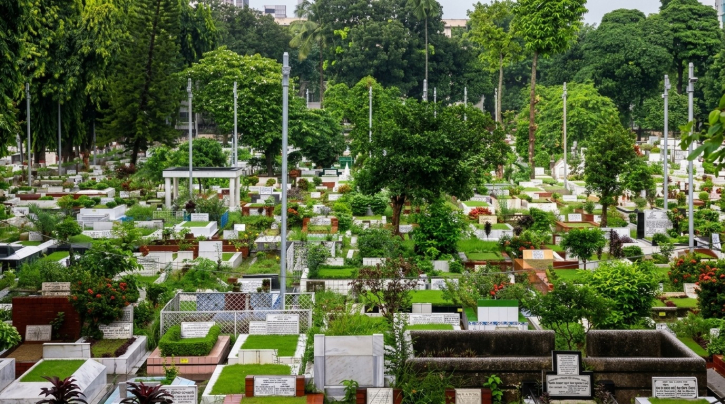
Banani Cemetery, located amid high-rise buildings and expensive residential and commercial properties, is one of the most visible examples of the situation. The amount required to preserve a grave there for an extended period is beyond the financial reach of many families.
According to information from relevant sources, preserving a grave after an ordinary burial at Banani Cemetery costs around Tk 3 crore for 15 years and approximately Tk 4.5 crore for 25 years. A typical grave measures about seven feet in length and three feet in width, or slightly more than 20 square feet.
Many people visit Banani Cemetery to inquire about preserving the graves of relatives or securing grave space for the future. However, having the financial capacity does not necessarily guarantee availability, as the shortage of land has become a major constraint.
The cemetery has more than 9,000 graves, including both long-term preserved graves and areas designated for ordinary burials.
The government registration fee for an ordinary grave is Tk 500. Additional prescribed expenses include digging the grave, bamboo and matting. An ordinary grave is generally retained for two years, after which the space is prepared for reuse.
In the case of preserved graves, designated family members can be buried there again. A fee of Tk 50,500 is charged for each subsequent reburial.
According to people familiar with the cemetery's management, the high cost of long-term grave preservation at Banani is primarily linked to limited land availability. If ordinary graves were extensively preserved for long periods, available space for new burials would rapidly decline. This is one of the reasons for setting higher fees for long-term preservation.
The shortage of burial space is not limited to Banani. Other cemeteries under the Dhaka North City Corporation are also facing increasing pressure.
Gautam Kumar Biswas, an official of DNCC's Social Welfare and Slum Development Department, said there are currently seven registered public cemeteries under Dhaka North City Corporation. These include Banani, Mirpur Shaheed Buddhijibi Cemetery, the cemetery adjacent to the Rayerbazar Martyred Intellectuals Memorial, and cemeteries in Uttara Sectors 4, 12 and 14 and Chamurkhan.
The Mirpur Shaheed Buddhijibi Cemetery covers 63.540 acres. From 1983 to June 2024, a total of 63,917 bodies were buried there.
The government registration fee for an ordinary burial there is Tk 500. Including bamboo, matting, grave digging and other prescribed expenses, the additional cost is Tk 1,456.
Long-term preservation, however, costs considerably more. Preserving a grave for 15 years costs Tk 20 lakh, while a 25-year preservation period costs Tk 30 lakh. In some ordinary areas, long-term preservation can cost up to Tk 90 lakh.
At Rayerbazar Cemetery, preserving a grave costs Tk 10 lakh for 15 years and Tk 15 lakh for 25 years.
Mohammad Harun-or-Rashid, a mohuror at Banani Cemetery, said graves sold at different times before 2007 are no longer owned by the city corporation. Those plots were privately owned and had been transferred through deeds.
The city corporation currently mainly manages and operates those graves, he said.
For burial, the deceased person's death certificate and a photocopy of the national identity card are required. In cases involving accidents or unnatural deaths, a post-mortem or autopsy report is also required, he added.
Under Dhaka South City Corporation, there are five listed cemeteries for Muslim burials: Azimpur, Jurain, Dhalpur Brahmanchirun, Muradpur and Khilgaon.
The registration fee for an ordinary burial at these cemeteries is also Tk 500. Including grave digging, bamboo, matting and other expenses, the total cost is around Tk 1,580 for an adult, Tk 1,210 for a medium-sized grave, and Tk 955 for a child.
Long-term preservation costs significantly more. At Azimpur Cemetery, the lease fee is Tk 5 lakh for 10 years, Tk 10 lakh for 15 years, Tk 15 lakh for 20 years and Tk 20 lakh for 25 years.
An average of 30 to 35 bodies are buried at Azimpur Cemetery every day. Although the size of the cemetery remains unchanged, the number of burials continues to increase. As a result, authorities have limited options other than reusing ordinary graves after a specified period.
Due to limited space, many cemeteries in Dhaka reuse old graves after a designated period. Once the prescribed period of an ordinary grave expires, a new body may be buried in the same space. At several cemeteries under the southern city corporation, ordinary graves are retained for around one year.
The system is also closely connected with family emotions. Many relatives wish to sit beside the graves of loved ones for years, place flowers regularly and preserve the graves indefinitely. However, limited urban land does not allow every family to do so.
Special arrangements are available for freedom fighters. At cemeteries under Dhaka North City Corporation, graves of freedom fighters buried in ordinary areas are preserved free of charge for 10 years. Authorities have also stated that lifetime preservation is available for freedom fighters at Rayerbazar.
Mohammad Mobasher Hasan, chief social welfare and slum development officer of DSCC, said graves not specifically designated as preserved graves are treated as ordinary graves. Once the specified preservation period expires, if relatives do not renew or extend the period, the grave becomes an ordinary grave and may subsequently be reused for another burial.
The land shortage becomes clearer when the cemetery management data of the two city corporations are examined.
The total area of cemeteries under Dhaka North City Corporation is approximately 192 acres, while cemeteries under Dhaka South City Corporation cover around 59 acres.
Although the need for burial space is increasing, cemetery land is not expanding at the same rate. Officials said Dhaka South City Corporation is working to identify land for new cemeteries. However, finding large plots of land in a densely populated capital is itself a major challenge.
Urban planning discussions generally focus on residential areas, roads, hospitals, educational institutions, parks, markets and commercial facilities. Cemeteries, despite being an essential part of the final stage of human life, receive comparatively less attention in urban planning.
Urban planners say the needs associated with birth, living and death should all be considered as part of comprehensive urban planning.
Professor Dr Akhtar Mahmud, former president of the Bangladesh Institute of Planners, said cemeteries are deeply connected with people's emotions, social memories and family histories. The high cost of long-term grave preservation is an indication of the depth of the cemetery-space crisis in the capital.
Mohammad Ashraful Islam, chief urban planner of the Rajdhani Unnayan Kartripakkha (RAJUK), said most Dhaka residents still bury their relatives in cemeteries in their ancestral villages. However, the tendency to bury family members in Dhaka may increase among younger generations who have permanently settled in the city.
He said the Private Land Development Rules provide for one acre of cemetery space for every 50,000 people. Considering Dhaka's current population and projected population growth, the amount of land required for cemeteries could reach several hundred acres.
The Detailed Area Plan (DAP) also recommends allocating small cemeteries in each ward.
Dhaka's population is growing, as are residential and commercial structures. Demand for land for roads, buildings and infrastructure is also increasing. However, land allocated as the final resting place for residents is not increasing at the same pace.
As a result, while an ordinary burial can be completed for several hundred or a few thousand taka, preserving a grave for an extended period can cost lakhs or crores. The approximately Tk 4.5 crore required to preserve a grave at Banani Cemetery for 25 years is an exceptional example of the rising value and scarcity of cemetery land in the capital.
On one hand, residential space for the living is becoming increasingly limited; on the other, securing a final resting place after death is also becoming more difficult.
The reuse of old graves after specified periods, fixed-term grave preservation and high fees for long-term preservation together show that the shortage of land has become an integral part of cemetery management in Dhaka.
A few feet of earth may be a person's final resting place. Yet in a rapidly expanding city, securing those few feet now brings together questions of money, land availability and long-term urban planning.
Subject-