
Dhaka’s Air Turns Unhealthy, Pollution Reaches Affluent Neighbourhoods
Published : 13:15, 8 November 2026
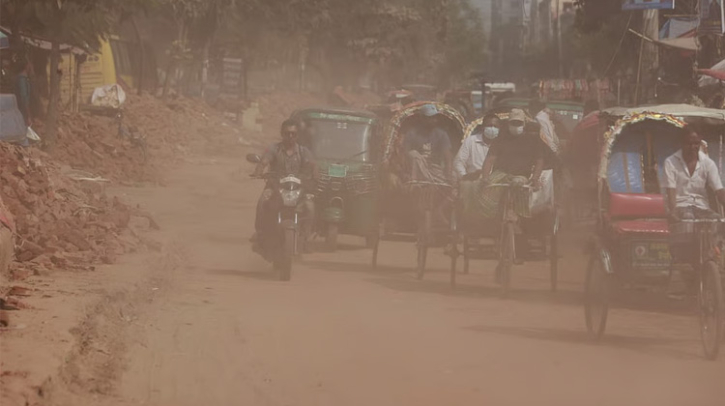
Air pollution is no longer confined to densely populated or low-income neighbourhoods in Dhaka. Even the capital's affluent residential areas, including Gulshan, Banani, Baridhara and Dhanmondi, are experiencing unhealthy air quality due to construction dust, vehicle emissions, waste burning and polluted air drifting in from surrounding areas.
Experts warn that if the trend continues, pollution could undermine the environmental advantages that have traditionally made these neighbourhoods attractive places to live and do business.
According to the Switzerland-based air quality monitoring organisation IQAir, Dhaka recorded an Air Quality Index (AQI) of 164 yesterday evening, placing the city in the ‘unhealthy’ category. At the same time, Dhaka ranked third among the world's most polluted cities, behind Kuwait City and Kolkata.
IQAir's local monitoring data showed that the highest pollution level in Dhaka was recorded near the Bangladesh Institute of Development Studies (BIDS) in Agargaon, where the AQI stood at 186.
Baridhara Park Road ranked second, with an AQI of 168. Pragati Sarani in Badda and Becharam Dewri each recorded 167. Baridhara Lakeside and Dhanmondi registered 161, Gulshan Lake Park 160, Eastern Housing in Banani 156, and the area near Grace International School in Gulshan-2 recorded 151. All these locations were within the unhealthy category.
Under the Air Quality Index scale, scores from 0 to 50 are considered ‘good’, 51 to 100 ‘moderate’ and 101 to 150 ‘unhealthy for sensitive groups’. Scores between 151 and 200 are classified as ‘unhealthy’, 201 to 300 as ‘very unhealthy’, and above 300 as ‘hazardous’.
For much of the year, Dhaka's air remains polluted because of construction activities, road dust, vehicle emissions and other human activities. The problem is no longer limited to densely populated or economically disadvantaged neighbourhoods; planned and affluent residential areas are also affected.
Experts say pollution in Gulshan, Banani and Dhanmondi comes not only from local sources but also from neighbouring areas. Smoke from cooking with traditional stoves and burning waste in Karail slum may reach Gulshan and Banani. Similarly, polluted air from Kamrangirchar could spread as far as Dhanmondi. Excavation and construction work along Pragati Sarani may also contribute to deteriorating air quality in Baridhara.
Dr. Ahmad Kamruzzaman Majumder, Dean of the Faculty of Science and Chairman of the Department of Environmental Science at Stamford University Bangladesh, said geographical and environmental factors could contribute to prolonged air pollution in affluent neighbourhoods near lakes.
He explained that high humidity and water vapour in the air above water bodies may prevent dust and smoke particles from dispersing easily. These particles can combine with moisture, become heavier and remain suspended or trapped in the surrounding air.
He added that temperature inversion during winter can also trap pollutants. When colder air remains near the lakeside at lower levels and warmer air stays above it, a layer forms that restricts vertical air movement. As a result, vehicle emissions and dust cannot rise and disperse easily, allowing pollutants to accumulate closer to the ground.
Dr. Mohammad Enayet Hossain, Associate Professor of the Department of Soil, Water and Environment at the University of Dhaka, said the concentration of high-rise buildings in areas such as Gulshan and Banani was an important factor contributing to air pollution.
According to him, closely spaced tall buildings obstruct the natural movement of air. This phenomenon is known as the ‘urban canyon effect’. Smoke from vehicles and nearby densely populated settlements can become trapped between buildings, making it difficult for the wind to disperse pollutants. Consequently, polluted particles remain close to ground level and increase local pollution.
Barrister Omar Sadat, President of Gulshan Society, identified emissions from private vehicles as one of the major sources of air pollution in Gulshan and Banani. He stressed the need for action against unfit vehicles and those emitting excessive black smoke.
He said a large number of unfit vehicles and smoke-emitting vehicles were still operating on Dhaka's roads. Alongside effective enforcement against such vehicles, he called for reducing corruption in the activities of the Bangladesh Road Transport Authority (BRTA).
Construction activities are another major source of dust, according to relevant stakeholders. They alleged that although construction sites are required to take protective measures to control dust, these measures are often not properly implemented. Despite legal and regulatory requirements, enforcement remains weak.
Shawkat Ali Bhuiyan (Dilon), President of Banani Society, said extensive construction work was underway in Gulshan and Banani. He noted that developed countries use multiple layers of protective measures to control dust during construction. Bangladesh also has relevant laws, he said, but proper enforcement must be ensured.
He further said pollution from Karail slum was affecting the surrounding environment. Improving living conditions for residents through essential civic facilities, including hospitals and clean markets, is important. He also called on the two city corporations to take effective measures to stop waste burning.
According to him, coordinated action by different agencies could improve air quality across the capital, including Gulshan, Banani and Dhanmondi.
Siddhartha Shankar Kundu, Deputy Secretary of the Ministry of Environment (Pollution Control-1), said the government was continuing its regular activities to control air pollution. A committee is also working on the issue, he said. The committee's upcoming meeting will review the concerns in detail and determine the next policy measures and course of action.
Subject-