

The Legal Foundation of Bangladesh’s Emergence: A Historical Overview of the Independence Declaration
Published : 01:04, 27 March 2026
In the historical context of Bangladesh's liberation struggle, the subject that frequently comes up for discussion is the brutal military massacre, 'Operation Searchlight,' carried out by the Pakistani forces on the night of March 25, 1971. The intensity and immediate impact of this genocide on the Bengali population were so severe that the question of Bangladesh's independence transcended mere political negotiations. It became clear that, in addition to the political realm, securing international recognition of independence became essential for the country’s emergence as a sovereign state.
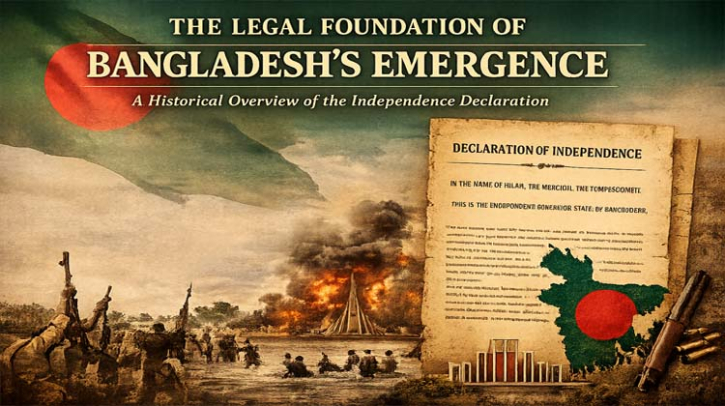
As part of military strategy, the declaration of independence on March 26, 1971, marked a crucial turning point. However, to globally validate the legitimacy of the Bangladeshi people's struggle for freedom, it was imperative to apply an internationally recognized legal framework for independence. This led to the promulgation of the Declaration of Independence on April 10, 1971. This document stands as the legal foundation for the birth of the new nation of Bangladesh. It eloquently frames the struggle for political, cultural, and economic freedom in legal terms, declaring the right of Bangladeshis to become an independent nation.
Political leaders made it clear in the Declaration that Bangladesh's right to independence was not an insurgent or separatist movement, but rather a legitimate war of liberation. International law refers to such declarations as a Unilateral Declaration of Independence (UDI), a process through which a population exercises its right to self-determination. Bangladesh’s Declaration of Independence is one of the first such cases in international law, where a post-colonial people were able to assert their right to self-determination.
At the time, the right to self-determination was largely applied in the context of decolonization. Bangladesh set a pioneering precedent by successfully applying this principle in a non-colonial context, asserting its right to independence and sovereignty. Prior to this, there had been no successful example of a non-colonial population using the right to self-determination to establish its independence.
This legal declaration not only solidified Bangladesh's standing on the global stage but also marked a new chapter in the history of post-colonial self-determination. It stands as a testament to the Bengali people's resolve and their determination to assert their sovereignty through legal means.