
Cemetery Crisis in Dhaka Takes Multiple Dimensions as Financial Pressure Grows Over Final Resting Places
Published : 18:29, 29 September 2026
The loss of a loved one is among the most emotionally difficult experiences in life. After a death, families have to make another deeply sensitive decision—where to bury their loved one and how long the grave can be preserved.
Many families prefer to bury their relatives in Dhaka. Yet, despite knowing that the grave may eventually be reused for another burial, families often have little choice because of their connection to the capital and the limited availability of burial space.
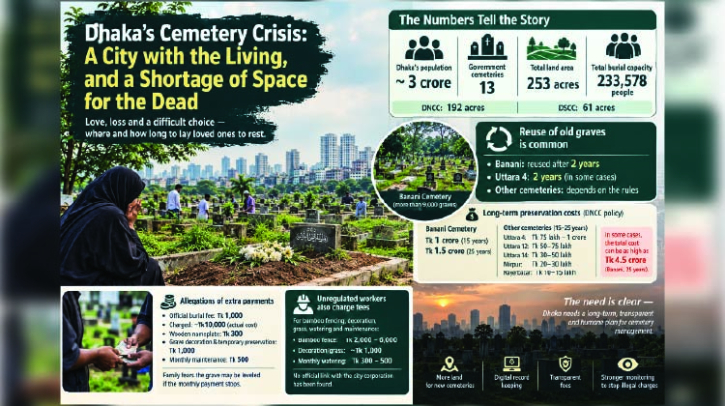
For those who can afford it, preserving a grave for an extended period has become an expensive proposition. At Banani Cemetery, for example, long-term preservation can involve costs ranging from Tk 1 crore to Tk 1.5 crore under the Dhaka North City Corporation (DNCC) cemetery policy, depending on the preservation period. In some cases, the total expenditure has reportedly reached as high as Tk 4.5 crore.
The situation highlights a growing challenge in Dhaka: alongside the housing crisis for the living, the city is also facing an increasing shortage of space for the dead.
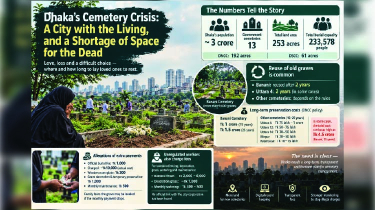
Dhaka, with a population of nearly three crore, has only 13 government cemeteries. Together, these cemeteries cover around 253 acres and have a combined burial capacity of 233,578 people. Of this land, 192 acres are under the Dhaka North City Corporation (DNCC), while only 61 acres are under the Dhaka South City Corporation (DSCC).
The shortage of cemetery land compared with the city's population is making burial management increasingly difficult. Reuse of old graves has become a regular practice in many cemeteries. In some places, a grave may be reused after two years, while families in other cases pay regularly to preserve the visible identity of a grave.
For those with sufficient financial means, however, graves can be preserved for 15 or 25 years by paying substantial fees. This has created a situation in which the duration for which a grave can remain preserved is closely linked to a family's financial capacity.
Limited cemetery space under growing pressure
According to city corporation data, Dhaka's 13 government cemeteries have a combined area of 253 acres and a burial capacity of 233,578 people.
Compared with the city's huge population, the available cemetery land is limited. People die every day, but cemetery land is not expanding at the same pace. As a result, reusing existing graves has become one of the practical responses to the shortage.
For grieving families, however, this creates another uncertainty: how long will their loved one's final resting place remain?
Different cemeteries have rules allowing the use of ordinary graves for a specified period. Once that period ends, a new body may be buried at the same location.
The pressure is particularly visible at Banani Cemetery, where there are more than 9,000 graves and available space for new burials has become increasingly limited. Ordinary graves are therefore being reused after two years.
A grave represents more than the burial place of an individual. It also carries a family's memories, relationships and history. But the shortage of space is increasingly limiting the ability of families to preserve those memories for long periods.
Long-term grave preservation costs millions of taka
Those who can afford it have the option of preserving graves for longer periods.
Under DNCC's cemetery policy, preserving a grave at Banani Cemetery costs Tk 1 crore for 15 years and Tk 1.5 crore for 25 years.
At Uttara Sector 4 Cemetery, the corresponding fees are Tk 75 lakh and Tk 1 crore. At Uttara Sector 12, the fees are Tk 50 lakh for 15 years and Tk 75 lakh for 25 years. At Uttara Sector 14, the fees are Tk 30 lakh and Tk 50 lakh respectively.
At Mirpur Martyred Intellectuals Cemetery, the fees are Tk 20 lakh for 15 years and Tk 30 lakh for 25 years. At the Rayerbazar cemetery adjacent to the Martyred Intellectuals Memorial, the fees are Tk 10 lakh and Tk 15 lakh for the same periods.
However, the report contains information suggesting that the actual expenditure can be higher than the prescribed fees in some cases. In particular, the total cost of preserving a grave at Banani Cemetery for 25 years has reportedly reached as much as Tk 4.5 crore.
This means that although families may wish to preserve the graves of their loved ones for longer periods, doing so is not equally affordable for everyone.
Allegations of additional payments surrounding burial and preservation
The shortage of cemetery space is not the only concern. There are also allegations of additional payments being demanded at different stages of burial and grave maintenance.
In April 2025, when Rafiqul Islam, a resident of Sutrapur in Old Dhaka, died, he was buried at Jurain Cemetery. According to a family member, the official burial fee set by the city corporation was Tk 1,000. However, the family spent around Tk 10,000 to complete the burial.
The family also alleged that they were charged Tk 300 for a wooden nameplate and another Tk 1,000 for decorating and temporarily preserving the grave. They were subsequently told to pay Tk 500 per month to keep the grave intact.
The family feared that if the monthly payment stopped, the grave could be levelled and another body buried there.
This means that, according to the allegations, a family's financial responsibility does not necessarily end with the burial; additional expenses may continue if relatives want to preserve the grave's identity and condition.
Allegations involving informal cemetery workers
Although city corporations have their own cleaners and hearse-related workers at cemeteries, reports indicate that informal workers are also active in some locations.
These individuals allegedly identify themselves as ‘support workers’ and provide services including burial assistance, grave decoration, bamboo fencing, planting grass, watering and regular maintenance.
There are allegations that they charge between Tk 2,000 and Tk 6,000 for bamboo fencing, around Tk 1,000 for decorating a grave or planting grass, and Tk 300 to Tk 500 per month for regular watering and maintenance.
No formal involvement of the city corporation in collecting these payments has been established in the report. However, questions have been raised over why effective action has not been taken against those allegedly collecting such money.
A worker who has been employed at Rayerbazar Cemetery for a long time reportedly acknowledged receiving such payments from families. He also alleged that part of the income goes to dishonest city corporation employees. The allegation, however, requires independent verification.
Under DNCC's Cemetery Policy-2022, permanent structures or fencing made of bamboo, bricks, iron grills or other materials are not permitted over ordinary graves.
Yet there are allegations that money is being collected for bamboo fencing, decoration and maintenance around graves.
This raises questions about how such activities are taking place inside cemeteries despite restrictions under the policy, who is collecting the money and what mechanisms exist to address complaints.
Multiple burials in preserved graves
Due to the shortage of space, there have also been instances where multiple members of the same family were buried in preserved graves. In some cases, as many as seven people have reportedly been buried in a single grave.
However, the opportunity for reburial is not open to everyone. According to the policy, it is limited to the deceased person's children, spouse, parents and siblings.
The arrangement further illustrates the depth of the shortage of burial space in the capital.
Grave preservation costs have risen significantly over time
The change in grave preservation costs becomes more apparent when the current situation is compared with older records.
According to available information, in 1996, purchasing a permanent grave space at Banani and Uttara Sector 4 cemeteries cost Tk 1.2 lakh. At Mirpur Martyred Intellectuals Cemetery, grave space was available for Tk 25,000 to Tk 35,000.
The purchase of permanent grave spaces was suspended between 2005 and 2007. From 2008, a time-based grave preservation system was introduced.
Before preservation fees were increased in 2023, the highest fee at Banani was Tk 24 lakh for 15 years and Tk 45 lakh for 25 years. The prescribed fees were subsequently increased significantly.
DNCC Chief Social Welfare and Slum Development Officer Mohammad Mamun-ul-Hasan said that the cost of ordinary burial had not generally been increased. He explained that high fees for long-term grave preservation were intended to discourage people from preserving graves for extended periods, as widespread preservation requests would further intensify the shortage of cemetery space in Dhaka.
The city corporation's explanation indicates that the shortage of cemetery land is one of the key reasons for limiting long-term preservation.
Need for long-term cemetery management plan
The central challenge for Dhaka's cemetery management is how to balance limited land with the demand for long-term grave preservation, while ensuring a transparent and humane system for families across different income groups.
A low- or middle-income family may try to spend a few hundred taka every month to preserve a loved one's grave for several years. A financially well-off family, meanwhile, may be able to spend millions of taka to preserve a grave for 15 or 25 years.
The experience of Abu Raihan, a resident of Uttara Sector 4, illustrates this disparity. After his maternal uncle Abdul Ali died, the family wanted to bury him in Dhaka but could not afford the high cost of preserving the grave. He was eventually buried in his ancestral village home in Kushtia.
The contrast between Dhaka's approximately three crore residents and its 253 acres of cemetery land lies at the heart of the problem. New burial space is required every day, but cemetery land is not increasing at the same rate.
As a result, old graves are being reused, long-term preservation involves substantial fees, and there are allegations of informal payments for grave maintenance, fencing, nameplates and other services.
The cemetery crisis in Dhaka is therefore not simply a shortage of land. It is also linked to management, economic disparity, transparency and allegations of irregular financial practices surrounding burial and grave preservation.
For a rapidly expanding metropolitan city like Dhaka, a long-term cemetery management plan is increasingly necessary. This should include developing new cemeteries in line with population growth, modernising existing cemeteries, maintaining digital burial records and ensuring transparency regarding burial and preservation fees.
Effective monitoring is also needed to prevent unauthorised collection of money and to ensure that complaints are addressed promptly.
A cemetery is a person's final resting place. While long-term preservation may remain an option for those who can afford it, the system should also consider whether ordinary families can reasonably preserve the graves of their loved ones.
With only 253 acres across 13 government cemeteries serving a city of nearly three crore people, Dhaka's burial-space challenge cannot be addressed solely through grave reuse or higher preservation fees.
What is needed is a long-term, transparent and humane cemetery management strategy that addresses both the shortage of land and the financial pressures faced by grieving families.
Because in the final stage of life, people leave behind wealth, status and power. What remains is a name, memories and a few hands of earth marking a final resting place. Ensuring that this final resting place does not become a source of unequal financial burden is an increasingly important question for Dhaka.