
The Political Use of the Term ‘Fascist’: A Question of Standards
Published : 21:23, 13 August 2026
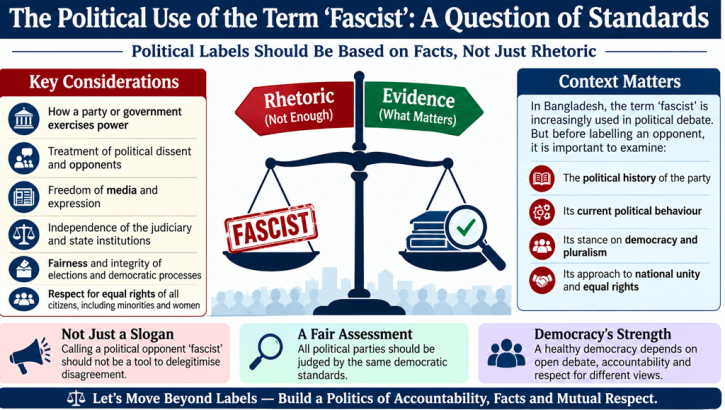
The use of the term “fascist” has increasingly become a prominent feature of political debate in Bangladesh. Different political parties and leaders have used the term while raising questions about the conduct of their opponents, the exercise of state power and the functioning of democratic institutions. Political analysts, however, argue that such a label should be assessed through political conduct, institutional practices and concrete actions rather than political rhetoric alone.
The issue has recently gained renewed attention as Jamaat-e-Islami and the National Citizens Party (NCP) have raised concerns about what they describe as authoritarian tendencies and the possibility of a drift toward fascist politics under the BNP government.
Questions concerning the use of state institutions, political opposition, freedom of expression and the concentration of power are central to these criticisms.
At the same time, no elected government can remain beyond public accountability. The democratic character of a government can be assessed by examining how it operates state institutions, treats political dissent, protects media freedom and maintains the independence and effectiveness of constitutional institutions.
The same standards should also apply to political parties. When one party questions the democratic credentials of another, its own political history, organisational practices and current positions may also become subjects of public discussion.
In this context, the political history of Jamaat-e-Islami remains an important part of Bangladesh’s political discourse. The party’s position during the 1971 Liberation War remains a deeply contested chapter of the country’s history. Its opposition to Bangladesh’s independence and the roles played by some of its leaders subsequently became subjects of legal proceedings and political debate.
Although Jamaat has sought to present its current political position in a different context, questions surrounding its historical role continue to be discussed in the public sphere.
The activities of Jamaat’s student organisation, Islami Chhatra Shibir, have also been the subject of political controversy and allegations of violence at different times. Any assessment of such allegations should be based on specific incidents, available evidence and the political circumstances in which they occurred.
The positions of Jamaat and other religiously oriented political parties on women’s rights, minority protection and the nature of a pluralistic state are also subjects of public discussion. In a modern democracy, protecting equal rights for religious and cultural minorities alongside the rights of the majority is an important test for every political organisation.
However, criticism of a political party should not automatically be extended to every individual member or supporter. A party should be evaluated separately on the basis of its policies, leadership statements, organisational conduct and proposed approach to governance.
The term “fascism” itself carries a specific political meaning. It is generally associated with highly concentrated political power, extreme political dominance, intolerance toward dissent, suppression of opponents and attempts to place state institutions under political control.
Therefore, before describing any political party or government as fascist, its actual political conduct should be carefully examined. Repeatedly using the term as a political slogan without evidence may reduce its analytical value.
The same standard applies to the BNP. As the governing party, it will be accountable for how it exercises state power, treats political opponents, protects media freedom, maintains judicial independence and preserves democratic institutions.
The NCP will also remain subject to public scrutiny over its political positions, alliances, decisions and future conduct. As a political force associated with the July movement, it will face expectations regarding democracy, accountability and political pluralism.
The central question for Bangladesh’s political discourse, therefore, should not simply be who calls whom “fascist.” The more important questions are how political parties exercise power, how they treat dissent, how independent they keep state institutions and how effectively they protect equal rights for citizens.
Applying the same standards to all political parties is essential for a healthy democratic system. The BNP should be held accountable for its actions in government; Jamaat-e-Islami should be evaluated in light of both its history and present political position; and the NCP should be judged by its political decisions and future conduct.
Ultimately, the character of a political party cannot be determined merely by the labels or slogans it uses. Voters and citizens assess political organisations through their policies, conduct, decisions and exercise of power.
For Bangladesh’s democratic future, political debate would therefore benefit more from evidence, historical context, institutional standards and scrutiny of actual conduct than from the repeated use of politically charged labels.
MDH