
Valuable Heavy Minerals Discovered in Nijhum Dwip Sands, Opening New Industrial Prospects
Published : 01:33, 13 August 2026
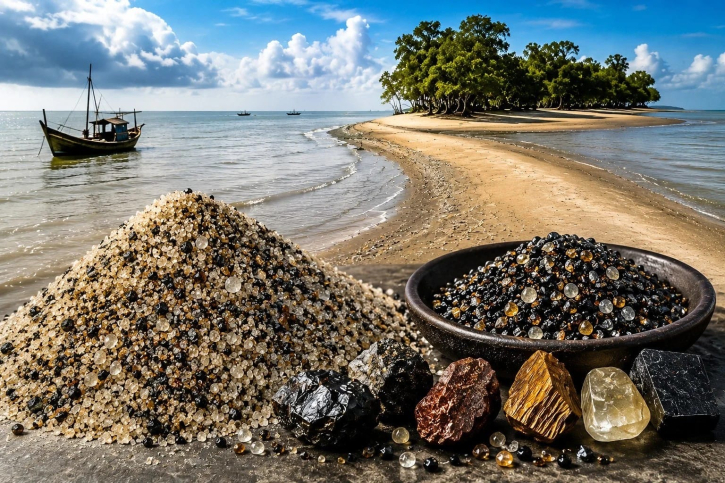
Researchers have identified significant concentrations of valuable heavy minerals in the beach sands of Nijhum Dwip, an island located at the Meghna estuary in the Bay of Bengal, raising hopes for the development of Bangladesh’s mineral-based industries.
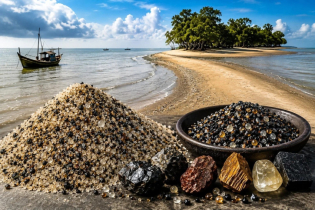
Recent mineralogical analysis found that nearly 25 percent of the beach sediment consists of Total Heavy Minerals (THM), including economically important minerals such as zircon, rutile, ilmenite, garnet, sillimanite, kyanite, monazite, and xenotime.
According to researchers, the discovery could open new opportunities for Bangladesh in mineral exploration, industrial raw materials, and value-added mineral processing. These minerals are widely used in ceramics, paints, metallurgy, welding electrodes, refractory products, and titanium-based industries.
Scientists say the mineral-rich sands were formed through geological processes involving sediments carried by the Ganges-Brahmaputra-Meghna river system from the Himalayas. Over thousands of years, river transport, tidal action, coastal currents, and wave activity concentrated the heavier mineral grains along parts of the coastline, including Nijhum Dwip.
The study identified a wide range of industrial minerals, including zircon, rutile, ilmenite, garnet, sillimanite, kyanite, monazite, xenotime, as well as amphibole and pyroxene group minerals. The magnetic fraction of the sand also contained minerals such as enstatite, biotite, pargasite, diopside, spinel, tremolite, titanite, hornblende, and several others.
To achieve accurate identification, researchers employed advanced X-ray Diffraction (XRD) analysis using Japan’s Rigaku SmartLab SE diffractometer. Mineral phases were subsequently confirmed through digital analysis with X’Pert HighScore Plus software.
The findings are part of a broader nationwide study covering approximately 5,481 square kilometres across Bangladesh’s eight major river systems. More than 6,600 sediment samples were collected, with over 800 samples undergoing detailed petro-mineralogical, chemical, and physical analyses to evaluate the country’s industrial mineral potential.
Among the discovered minerals, zircon, rutile, and ilmenite are particularly valuable for producing titanium-based materials used in ceramics, pigments, and advanced manufacturing. Garnet has applications as an industrial abrasive, while sillimanite and kyanite are widely used in refractory industries due to their high heat resistance. Monazite and xenotime are also considered strategically important as potential sources of rare earth elements.
Researchers caution, however, that a high concentration of heavy minerals alone does not automatically indicate a commercially viable mineral deposit. Detailed assessments of reserve size, depth, mineral grades, extraction feasibility, processing costs, and environmental impacts will be required before any commercial mining can be considered.
Given that Nijhum Dwip is an ecologically sensitive coastal island, any future mineral development must carefully balance economic benefits with environmental conservation and biodiversity protection.
Nevertheless, researchers believe the discovery represents a significant milestone for Bangladesh. With further exploration and responsible resource management, the country’s coastal sediments could become an important domestic source of industrial minerals, reduce reliance on imports, and create new opportunities for mineral processing and exports in the future.
Subject-