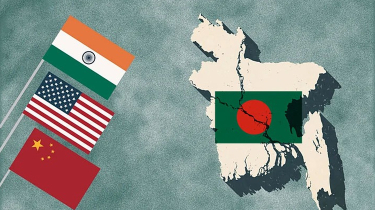

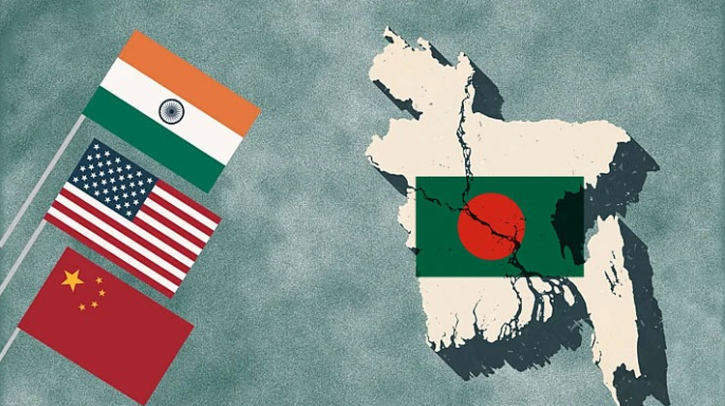
Bangladesh at the Centre of China-India-US Strategic Interests
Published : 19:46, 20 September 2026
Bangladesh’s foreign policy is increasingly operating within a complex geopolitical environment shaped by the economic, strategic and security interests of major powers. While trade and economic ties with the United States continue to evolve, cooperation with China is expanding in infrastructure, investment and technology. At the same time, relations with neighbouring India remain closely linked to trade, connectivity, energy, water management and security.
Against this backdrop, one of Bangladesh’s key diplomatic challenges is to expand cooperation with major partners while preserving national interests and strategic decision-making autonomy.
The long-standing principle of Bangladesh’s foreign policy—“friendship to all, malice toward none”—is gaining renewed importance amid growing global competition. However, Bangladesh’s relations with the United States, China and India are different in nature, with each relationship involving distinct interests and areas of cooperation.
A New Review of Bangladesh-India Relations
Bangladesh and India share an extensive relationship shaped by geography, a long land border, trade, electricity, connectivity, security, water resources and cross-border economic activities.
The recent initiative to review 101 agreements and memorandums of understanding signed with India during previous periods has added a new dimension to bilateral discussions. Such a review can examine the legal framework of the agreements, their implementation, economic outcomes, mutual benefits and long-term obligations.
Regardless of the eventual outcome, the review provides an opportunity to assess existing bilateral arrangements in light of Bangladesh’s current economic and strategic priorities.
Water management, border issues, trade, electricity and regional connectivity are also expected to remain important areas of engagement between Dhaka and New Delhi. The 1996 Ganges Water Sharing Treaty, whose current term is due to expire in December 2026, is particularly significant for future bilateral discussions.
Trade and Economic Ties with the United States
Trade remains one of the major pillars of Bangladesh-US relations. The United States is an important export market for Bangladesh, particularly for ready-made garments. Cooperation is also expanding in areas such as investment, technology, energy and supply-chain development.
On February 9, 2026, Bangladesh and the United States signed an “Agreement on Reciprocal Trade”. The agreement aims to structure market access and strengthen the framework of bilateral trade relations.
For Bangladesh, greater access to the US market can create opportunities not only for exports but also for investment and participation in international supply chains. At the same time, trade policy needs to take into account market diversification, export competitiveness and long-term economic interests.
Expanding Infrastructure Cooperation with China
China is one of Bangladesh’s largest trading partners and an important infrastructure partner. Chinese involvement covers areas including roads, bridges, power, industrial zones, technology, connectivity and development projects.
During the Bangladesh prime minister’s visit to China in June 2026, the leadership of the two countries discussed expanding economic and strategic cooperation. Modernisation of Mongla Port, industrial and economic zones, green energy, technology and water management have also featured in discussions on bilateral cooperation.
For Bangladesh, the relationship with China involves not only infrastructure and investment but also opportunities to expand exports, improve trade balance and strengthen technological and industrial capacity.
As imports from China remain substantially higher than exports to the Chinese market, reducing the trade imbalance can remain an important objective of Bangladesh’s economic diplomacy. At the same time, financing structures, loan terms, local economic impacts and long-term financial obligations should form part of the assessment of major projects.
The Teesta and Regional Geopolitics
Integrated management of the Teesta River is important for Bangladesh in terms of water resources, agriculture, environmental management and regional connectivity. Potential cooperation with international partners, including China, can have economic and technological significance, while the issue also remains relevant to Bangladesh’s relationship with India.
Major regional projects therefore require consideration not only of financing and technology but also environmental impacts, operating costs, long-term financial obligations and regional relations.
Energy Security and Foreign Policy
Energy security is becoming increasingly connected with Bangladesh’s foreign policy and economic interests. Dependence on imported LNG and other fuels means that international prices, supply chains and maritime security can have direct implications for industrial and power generation.
Diversifying energy suppliers, increasing domestic gas exploration, developing energy infrastructure and strengthening strategic reserves are therefore becoming increasingly important elements of Bangladesh’s economic diplomacy.
Different Relationships, Different Priorities
Bangladesh’s relationships with China, India and the United States cannot be viewed through the same framework.
The United States is an important export market and economic partner. China is a major partner in infrastructure, industry and investment. India, as Bangladesh’s immediate neighbour, has direct importance in connectivity, electricity, trade, water resources and security.
Therefore, Bangladesh’s foreign policy can benefit from a sector-based approach rather than applying a single framework to all three relationships.
Where markets are needed, Bangladesh can focus on market access; where investment is required, on investment partnerships; where technology is needed, on technology cooperation; and where national security and sovereignty are involved, on long-term strategic planning.
Bangladesh’s Emerging Diplomatic Priorities
Bangladesh’s geopolitical significance is shaped by its geographical position, large population, economic potential, location along the Bay of Bengal and its potential role as a bridge between South and Southeast Asia.
Bangladesh cannot remain completely outside competition among major powers. At the same time, it has room to maintain economic and strategic cooperation with multiple partners while prioritising national interests.
This requires stronger institutional capacity, transparent agreements, economic assessment of major projects, diversified trade and investment partnerships, and systematic evaluation of the long-term implications of major policy decisions.
The future of Bangladesh’s foreign policy, therefore, is less about choosing one major power and more about managing different relationships according to specific national interests. Trade and investment with the United States, infrastructure and industrial cooperation with China, and neighbourhood relations, connectivity and water management with India each have their own significance.
A multi-dimensional foreign policy is not new for Bangladesh. However, its importance has increased amid the changing global order. Balancing economic growth, trade expansion, energy security, technological development and regional stability will be central to Bangladesh’s ability to translate its geopolitical position into long-term national interests.
Subject-