
Historical Context Matters More Than a Photograph
Published : 15:35, 19 September 2026
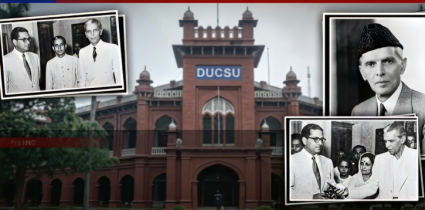
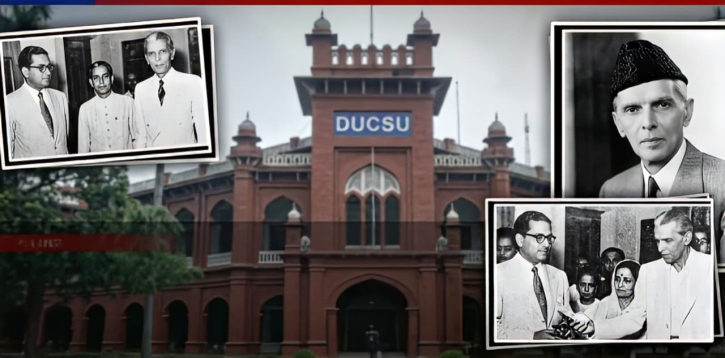
A photograph or symbol alone cannot define history. What matters more is presenting the full historical context surrounding a person, event or political development. The display of photographs of Pakistan’s founder Muhammad Ali Jinnah and Abdul Malek, a leader of the then Islami Chhatra Sangha, at the Dhaka University Central Students’ Union (DUCSU) museum has brought renewed attention to how historical figures and events should be documented and presented.
Following renovation, the DUCSU museum added several photographs and archival materials related to major political and historical developments. Among the materials are photographs of Muhammad Ali Jinnah, including an image from his 1948 address in Dhaka, a group photograph from the 1940 Lahore session and a newspaper clipping related to the 1970 election. Photographs and materials relating to Abdul Malek have also been included. DUCSU representatives have said that such materials are intended to document historical events and figures rather than glorify them.
The historical context of the language question is particularly important. On 25 February 1948, Dhirendranath Datta raised a demand in Pakistan’s Constituent Assembly for Bengali to be recognised for use in the assembly proceedings. The issue subsequently became an important part of the broader Bengali language movement, which culminated in the Language Movement of 1952.
Muhammad Ali Jinnah, meanwhile, addressed a public gathering at the then Racecourse Maidan in Dhaka on 21 March 1948 and declared Urdu to be the sole state language of Pakistan. Banglapedia’s account of the Language Movement also records his position on the language question. Jinnah died on 11 September 1948, several years before the Language Movement reached its decisive phase in 1952.
The historical background of Abdul Malek also requires contextual presentation. In 1969, student organisations in Dhaka were deeply divided over the education policy proposed by the Pakistani government. Abdul Malek, who was associated with the Islami Chhatra Sangha, took part in debates surrounding the issue and was later injured in a clash before dying in hospital. Contemporary reports and later historical accounts provide different perspectives on the circumstances, while available sources do not conclusively identify specific individuals responsible for the fatal assault.
The role of the Islami Chhatra Sangha during the Liberation War is another part of the historical record that requires documentation. Judicial records published by the Supreme Court of Bangladesh have discussed the organisation's relationship with Jamaat-e-Islami Pakistan and its role in the formation and activities of Al-Badr during the 1971 Liberation War.
For that reason, the presence of a photograph of a historical figure in an archive should not, by itself, be interpreted as an endorsement of that person's political views or actions. At the same time, displaying a photograph without sufficient context can leave room for misunderstanding. An effective museum presentation should therefore provide the relevant speeches, political positions, contemporary documents, historical consequences and, where applicable, judicial findings alongside the photographs.
The history of Bangladesh was shaped through a long sequence of political and social developments—from the demand for recognition of Bengali in 1948 and the Language Movement of 1952 to the Six-Point Movement, the 1969 mass uprising, the 1970 election and the Liberation War of 1971.
A historical archive therefore has a responsibility not simply to display familiar or popular figures, but to preserve evidence from different periods and explain their historical significance. Presenting documented facts, contemporary records and subsequent developments together allows students and visitors to understand the past without reducing it to a single photograph or political slogan.
History is best preserved when events are neither erased nor presented without context. For museums and archives at educational institutions, including DUCSU, the combination of photographs, primary documents, historical explanations and reliable sources can provide a more complete account of the past.