
Three Generations of History on One UN Stage: Tarique Rahman to Represent Bangladesh
Published : 13:16, 23 September 2026
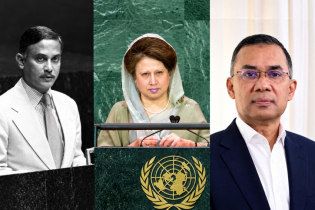
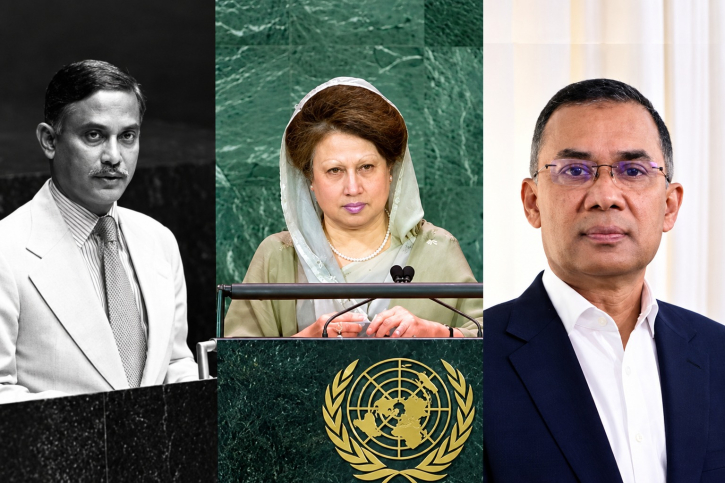
At the United Nations headquarters in New York, three distinct chapters of Bangladesh's history are set to converge on the same global stage. More than four decades ago, the late President Ziaur Rahman stood at the United Nations and raised questions about inequality in the global system, poverty, and the rights of people deprived of development opportunities. His wife and former Prime Minister Khaleda Zia later represented Bangladesh at the same international forum.
Now, continuing that sequence, Prime Minister Tarique Rahman is set to address the United Nations General Assembly for the first time on behalf of Bangladesh.
His speech on September 24, 2026, is set to mark a significant chapter in the international presence of the third generation of the Zia family.
The event cannot be viewed merely as another state visit or a routine diplomatic engagement. It carries a broader historical significance, linking Bangladesh's evolving state outlook, longstanding questions of global justice and the international presence of three generations of a prominent political family.
The story began in 1980
The first chapter of this history began in 1980.
On August 26 that year, the late President Ziaur Rahman addressed the 11th Special Session of the United Nations General Assembly in New York.
The global economy was going through a period of severe crisis. Rising oil prices, debt and economic vulnerability in developing countries, and widening disparities between developed and developing nations were among the major issues dominating international discussions.
Against this backdrop, Ziaur Rahman questioned why millions of people around the world continued to live in poverty and hunger despite repeated commitments to development and international cooperation.
His argument was not rooted solely in Bangladesh's domestic circumstances. It was also connected to the broader international debate over development thinking at the time.
On one side was modernization theory. Ideas such as W. W. Rostow's Stages of Economic Growth suggested that developing countries could gradually reach an economic “take-off” if they followed appropriate economic structures and received sufficient capital, technology and foreign assistance.
On the other side, dependency theory highlighted the unequal relationship between the global economic “core” and “periphery.” From this perspective, structural inequalities in international trade and economic systems made it difficult for developing countries to fundamentally change their position.
The international manifestation of this debate included the New International Economic Order, or NIEO, proclaimed by the United Nations in 1974. Discussions over North-South economic relations also gained prominence in subsequent years.
The question of international economic cooperation and a new global economic structure remained important during the UN's 11th Special Session in 1980.
Bangladesh at the time was a young, war-ravaged country struggling with poverty and food insecurity. The impact of the 1974 famine remained significant, while food production, employment, and economic reconstruction were among the country's major challenges.
Against this backdrop, Ziaur Rahman's position focused on the question of fair participation for developing countries. He called for a more equitable international framework in trade, development assistance, loans, energy, and market access.
He also advanced the view that wealthy and oil-producing countries had responsibilities alongside developed nations in reducing the pressure of global economic crises on poorer countries.
Another important element of his position was the idea of self-reliance.
For him, self-reliance did not mean isolation from the international community. Rather, it meant strengthening domestic production and national capacity so that Bangladesh could participate in the international system on an equal footing.
Thus, his approach combined calls for global cooperation and fair trade with an emphasis on agriculture, food production and domestic capacity-building.
Khaleda Zia and the second chapter
Nearly 13 years after Ziaur Rahman's appearance at the United Nations, his wife, Khaleda Zia, represented Bangladesh at the UN General Assembly.
Her address to the 48th General Assembly on October 1, 1993, marked the beginning of the second generation's diplomatic presence at the international forum.
She subsequently addressed various important UN programmes, including the commemorative session marking the 50th anniversary of the United Nations in 1995, the Special Session on Children in 2002 and events surrounding the 60th General Assembly in 2005.
Her repeated appearances at important UN forums between 1993 and 2005 created a continuing platform for presenting Bangladesh's national positions and priorities to the international community.
Now comes the third generation
The third generation is now set to join that history.
Prime Minister Tarique Rahman departed Dhaka for New York on September 21. On September 24, he is scheduled to address the 81st session of the United Nations General Assembly for the first time as Bangladesh's representative.
According to the government's stated agenda, his speech is expected to address Bangladesh's democratic transition, the rule of law, accountability, global peace and security, climate change, sustainable development, economic cooperation, women's and youth empowerment, education and healthcare, the Rohingya crisis, equitable access to modern technology and reform of the multilateral system.
These issues demonstrate how dramatically Bangladesh's international priorities have evolved since 1980.
During Ziaur Rahman's time, the central issues surrounding global justice included food, oil, trade, development assistance and economic inequality.
Four decades later, the agenda has expanded to include climate change, carbon emissions, technology, artificial intelligence, the digital divide, climate finance and rising sea levels.
Climate change and Bangladesh's diplomatic priorities
Climate change is particularly important for Bangladesh.
On September 23, the Prime Minister is expected to participate in a high-level meeting on “Climate Action and the Just Transition” initiated by the UN Secretary-General. The following day, he is scheduled to deliver the opening remarks at a UN high-level meeting on existential risks arising from sea-level rise.
For Bangladesh, climate change is not merely an environmental policy issue. It is directly connected to coastal settlements, agriculture, water security, livelihoods and migration.
Bangladesh's contribution to global greenhouse gas emissions is relatively small, yet the country remains highly vulnerable to the impacts of climate change. Cyclones, storm surges, salinity, river erosion and rising sea levels could collectively have long-term consequences for the country's development.
According to World Bank estimates, Bangladesh suffers average annual economic losses of around $1 billion from cyclones alone. As a result, climate finance, adaptation, technology transfer and equitable burden-sharing are becoming increasingly important elements of Bangladesh's diplomacy.
This is where the question of development justice raised in 1980 returns in a new form.
At that time, the central question was how to ensure fair trade and development assistance for poorer countries. Today, the question is who should bear the cost of adaptation for countries that have contributed relatively little to climate change, and how necessary technology and financing can be secured.
The question of technology equity
Similar questions are emerging in the field of technology.
Artificial intelligence, digital infrastructure and emerging technologies are rapidly reshaping the global economy. Yet the benefits of these technologies are not equally accessible to all countries.
If disparities in advanced technology, skills, infrastructure and financing continue to widen, new forms of core-periphery relationships could emerge in the global economy.
For Bangladesh, ensuring equitable access to technology and strengthening national capacity could therefore become an increasingly important international priority.
The Rohingya crisis
Another major issue during Tarique Rahman's UN visit will be the Rohingya crisis.
Following violence in Myanmar in 2017, a large number of Rohingya refugees sought shelter in Bangladesh. Nearly nine years later, a significant portion of the population remains in Bangladesh.
The crisis is no longer solely a humanitarian issue. It is increasingly linked to Bangladesh's economy, environment, border security and regional stability.
In 2026, the United Nations and partner organisations have appealed for $710.5 million to meet the needs of Rohingya refugees and the local communities hosting them. Maintaining international funding for such a prolonged crisis, however, is becoming increasingly difficult.
Bangladesh's position has remained clear: the Rohingya crisis originated in Myanmar and a sustainable solution must ultimately be found in Myanmar. Repatriation must be safe, voluntary, dignified and sustainable.
The UN platform provides Bangladesh with another opportunity to reiterate that position before the international community.
A significant diplomatic coincidence for Bangladesh
Another feature of this year's UN General Assembly gives Bangladesh's diplomatic presence added significance.
Bangladesh's Foreign Minister Dr. Khalilur Rahman has been elected President of the 81st session of the General Assembly. He reportedly received 99 votes from the 193 UN member states in an election held at UN headquarters on June 2.
This makes him the second Bangladeshi, after Humayun Rashid Choudhury, to hold the important position.
As a result, during the same General Assembly session, Bangladesh's Prime Minister will address the General Debate as head of government while the country's Foreign Minister will preside over the General Assembly.
For Bangladesh, this represents a notable diplomatic convergence.
A legacy of the past, expectations for the future
Taken together, the 2026 UN General Assembly can also be viewed as part of a three-generation international trajectory associated with the Zia family.
In 1980, Ziaur Rahman faced the challenge of sustaining a post-war Bangladesh, addressing food and poverty crises and securing a fairer place for the country within the international economic system.
During Khaleda Zia's leadership in the 1990s and beyond, Bangladesh faced questions surrounding democratic state identity, economic development, international cooperation and a more active role in multilateral diplomacy.
In 2026, Tarique Rahman faces a substantially different global environment—climate change, rising sea levels, the Rohingya crisis, rapid technological transformation, global economic uncertainty, international security, and reform of the multilateral system.
Placing these three periods side by side makes one point clear: the nature of the questions has changed, but the need to protect Bangladesh's interests and dignity on the international stage remains.
The voice that spoke in 1980 about the rights of developing countries in the face of global inequality was followed by Khaleda Zia's continued international presence. Tarique Rahman is now entering the third chapter of that history.
His first UN address therefore represents both an inheritance from the past and a bridge toward future expectations.
The ultimate significance of the visit, however, will depend on how much new policy direction emerges from his September 24 speech, how Bangladesh's global priorities are presented, and whether those positions can translate into meaningful cooperation with international partners.
On the UN stage, Bangladesh's contemporary concerns are expected to come into focus—democracy, development, climate justice, Rohingya repatriation, technological equity, economic cooperation and an effective multilateral world order.
For the three generations of the Zia family's international journey, September 24 is therefore more than a date. It represents a moment when three different periods of Bangladesh's political and state history converge on the same global stage.
The world will now be watching what message Bangladesh delivers as it carries the lessons of the past into an increasingly complex global future.