
Prime Minister Seeks Students’ Support to Maintain Stability for Nation Building
Published : 01:17, 13 May 2026
Prime Minister Tarique Rahman has called on students of the University of Dhaka to help maintain a stable political environment in order to build the nation and move the country forward.
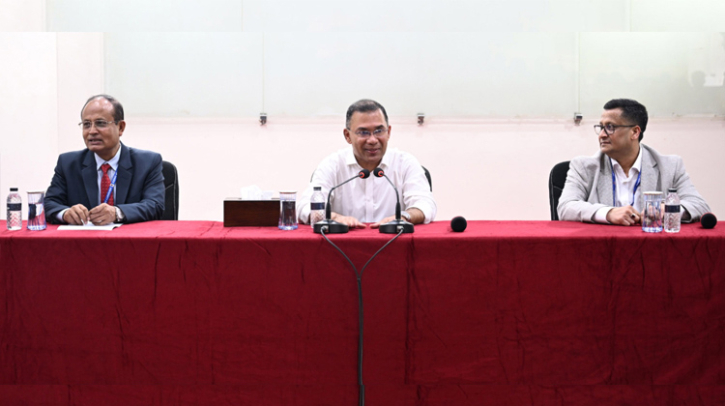
He made the call today while speaking directly with students at the Professor Muzaffar Ahmad Chowdhury Auditorium of the Social Sciences Faculty at Dhaka University.
The Prime Minister also urged students to learn a third language alongside Bangla and English to increase employment opportunities across the world.
A total of 156 students from different faculties of the university participated in the interactive session. Among them, 17 students asked questions regarding various government plans and initiatives, which the Prime Minister answered with a smile.
Kaberi Azad, a postgraduate student of the Drawing and Painting Department under the Faculty of Fine Arts, asked whether the government has any plans to expand the country’s art market and support artists.
Responding to her question, the Prime Minister said that building a stable environment is essential for implementing any long-term initiative.
“We cannot build anything meaningful without political stability. If the political situation remains unstable, whatever we create today may collapse tomorrow. Therefore, a stable environment is necessary,” he said.
He added that students have a major role in maintaining stability, whether through social media or other platforms.
“We will continue politics through democratic processes and parliamentary practices. Merely creating noise on the streets cannot build a nation. Constructive discussions and careful planning are essential for sustainable development,” he said.
The Prime Minister said the younger generation must come forward with responsibility, courage and constructive opinions because they are the future of the country.
Highlighting a government initiative, he said school students are now being taken to parliament to learn about the country’s democratic institutions, parliamentary traditions and history.
He recalled his own experience of visiting the British Parliament and said the guided tour system there inspired him to introduce a similar initiative in Bangladesh for students.
At the beginning of his speech, the Prime Minister shared memories of returning to Dhaka University after nearly 35 years.
“Seeing all of you reminds me of my own student days,” he said, adding that he had wished to walk through the campus and revisit old memories.
During the session, students also raised concerns about accommodation shortages in university halls, lack of employment opportunities, question paper leaks, nepotism and corruption in recruitment processes.
In response, the Prime Minister said corruption and large-scale financial irregularities over the years have negatively affected the country’s ability to address many public problems.
He referred to corruption allegations surrounding major projects and said billions of dollars had been siphoned out of the country over the years, making it difficult to solve all problems immediately despite the government’s intentions.
He also said achieving “zero tolerance” against corruption is difficult in reality, but the government is trying to bring the situation under control gradually.
Speaking on social attitudes and ethical awareness, the Prime Minister said many people still fail to recognize everyday negligence and unethical practices as forms of corruption.
Referring to higher education, he expressed concern that Dhaka University still does not rank prominently in international rankings. He attributed this partly to politically biased recruitment practices in the past.
“If teachers are recruited based on merit, academic results and qualifications, the situation can improve significantly,” he said.
Another student, Al Amin, raised concerns over the declining importance of Bangla among English-medium students.
In reply, the Prime Minister said language identity largely depends on family values and social environment.
He cited the example of his daughter, saying despite spending many years abroad, she remains fluent in Bangla and connected to the country’s culture and geography.
He also criticized the tendency of some families to communicate only in English with children studying in English-medium institutions, saying this habit weakens attachment to the mother tongue.
Earlier in the day, the Prime Minister inaugurated a workshop titled “Transformation of Higher Education in Bangladesh: Roadmap for Sustainable Excellence,” organized by the University Grants Commission of Bangladesh at the Nawab Nawab Ali Chowdhury Senate Building of Dhaka University.
After the workshop, he joined the student interaction session at the Social Sciences Faculty auditorium.
Vice-Chancellor Professor A B M Obaidul Islam and Professor Morshed Hasan Khan were present on the stage during the event.
At the end of the programme, Dhaka University authorities presented commemorative souvenirs to the Prime Minister.
Subject-