
November 7 Is the ‘Magna Carta’ of Independent Bangladesh’s History: Prime Minister
Published : 11:59, 7 November 2026
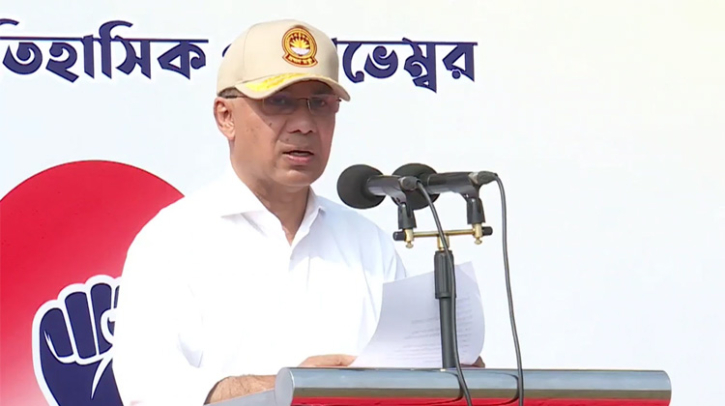
Prime Minister Tarique Rahman has described November 7 as the “Magna Carta” of the history of independent Bangladesh.
He said time had demonstrated that November 7, 1975, was the day that determined the future course of Bangladesh. Whenever the country deviated from the path set by November 7, the sovereignty of the nation and its people came under threat, he added.
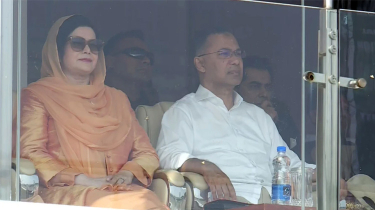
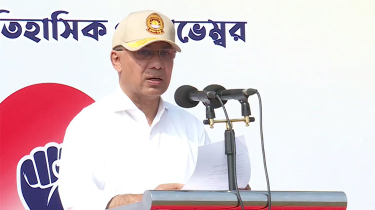
The prime minister made the remarks at a programme held at the Army Stadium on Saturday, November 7, marking the historic National Revolution and Solidarity Day.
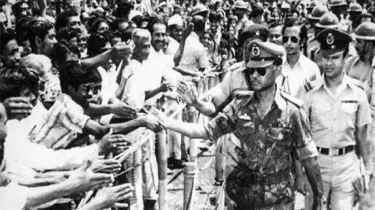
Tarique Rahman said that on November 7, 1975, patriotic soldiers and civilians had united to thwart all conspiracies against Bangladesh’s independence and sovereignty. He described the day as a turning point in the country’s history for identifying friends and foes.
He said conspiracies against Bangladesh had reached their peak during the first week of November 1975. As part of those developments, then Army Chief Lieutenant General Ziaur Rahman was placed under house arrest along with his family in the early hours of November 3. The prime minister said the soldiers and civilians had united to thwart the conspiracy against the country's interests that had begun with the confinement of the Proclaimer of Independence.
According to the prime minister, the historic revolution of November 7 defeated those who wanted to turn Bangladesh into a subservient state, strip people of their democratic rights, establish one-party rule and undermine the honour and prestige of the armed forces.
He further said the conspiracies of the defeated forces of November 7 had never stopped. They had later turned the country into a subservient state once again. He also alleged that a planned massacre of army personnel at Pilkhana had undermined the army’s honour and prestige, while democratic rights were taken away and a fascist regime was established.
Tarique Rahman said the defeated forces had been defeated once again in 2024 through a bloody mass uprising led by students and people, at the cost of thousands of lives. As a result, he said, the country had been freed from fascism.
Drawing parallels between the movements of 1975 and 2024, the prime minister said the 1971 war had been fought to achieve independence, while the 2024 movement was aimed at protecting the freedom of the country and its people. Just as people from all walks of life took to the streets on August 5, 2024, soldiers and civilians had united on November 7, 1975, to resist conspiracies against the country’s independence and sovereignty, he said.
Emphasising national unity, the prime minister said that regardless of political views, religion or ethnicity, all citizens of Bangladesh shared one identity: “We are Bangladeshis.” He said this identity had united the nation and that November 7 had laid the foundation for that national identity.
He said the significance of the united revolution by soldiers and civilians on November 7 would remain relevant as long as Bangladesh existed. The heroes of the historic day, he said, were the patriotic soldiers and civilians.
Highlighting the role of the younger generation, Tarique Rahman said a nation’s history was not merely a recollection of the past. An accurate understanding of history, he said, inspired national identity, self-respect and the building of a prosperous future. If a history-conscious younger generation remained inspired and united by the spirit of November 7, Bangladesh would never lose its way, he added.
The prime minister said the main pledge of this year’s November 7 should be to ensure that no one could deprive the people of their rights or turn Bangladesh into a subservient state again. He stressed that there was no alternative to national unity in fulfilling this commitment.
Concluding his speech, he said achieving independence was a matter of historic pride, but preserving that pride and making independence meaningful was the responsibility of every generation. He urged the younger generation to dedicate themselves to building a safe, prosperous, humane and dignified Bangladesh.
Expressing his commitment to national unity, the prime minister said: “Not Delhi, not Pindi, nor any other country—Bangladesh comes first.”