
Bangladesh Wants to Build a Prosperous, Self-Reliant and Welfare-Oriented Democratic State: PM
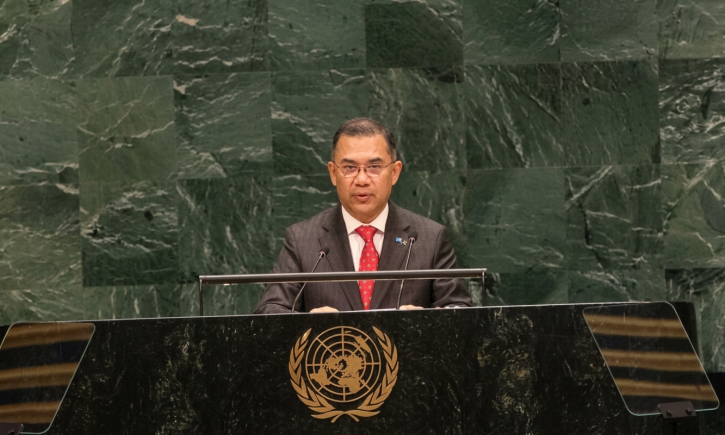
Published : 10:28, 25 September 2026
Bangladesh wants to establish a prosperous, self-reliant, and welfare-oriented democratic state by ensuring the political and economic empowerment of its people, Prime Minister Tarique Rahman has said.
He said ensuring equal rights, respect and dignity for all citizens irrespective of political affiliation, religion or race is a fundamental objective of the state.
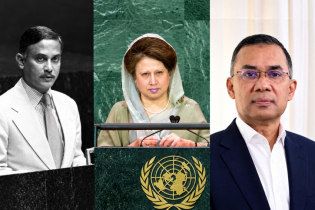
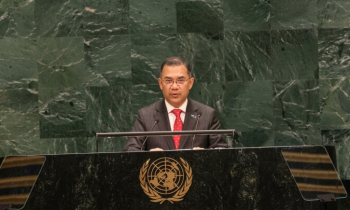
The prime minister made the remarks in his maiden speech in Bangla during the general debate of the 81st session of the United Nations General Assembly at the UN headquarters in New York on Thursday. His roughly 21-minute address covered Bangladesh’s democratic journey, economic development, education, technology, climate change, the Rohingya crisis, peace and multilateral cooperation.
Focus on Economic Empowerment
Prime Minister Tarique Rahman said a new horizon of opportunities has opened before Bangladesh. He said the government is working to transform the country’s working-age population into skilled human resources by taking advantage of the demographic dividend, create extensive employment opportunities and establish Bangladesh as a “manufacturing hub.”
He said US$50 million has been allocated in the current fiscal year to support startup initiatives and create opportunities for young entrepreneurs, researchers and innovators.
The prime minister said the government wants to ensure not only electoral democracy but also the democratisation of the economy so that the benefits of economic growth and prosperity reach every family and citizen.
Emphasising women’s empowerment, he said women account for more than half of the country’s population and therefore women’s education, employment and entrepreneurship have been placed at the forefront of government plans.
He highlighted expanded cash-financing opportunities for women entrepreneurs, particularly in the small and medium-sized industries sector, as well as opportunities for women to receive free education up to the undergraduate level.
The government has also introduced social protection programmes including the Family Card, Farmers’ Card, Sports Card and e-Health Card for economically disadvantaged people, he said. The Family Card, issued in the name of the female head of a household, is a symbol of women’s economic empowerment, he added. The government also plans to introduce a “Universal Card” by integrating the different sector-based cards.
Education and Skilled Human Resources
The prime minister said education, health and sports have been given special priority. He said the country has allocated its highest-ever budget for education and plans to gradually raise education expenditure to 5 percent of GDP within the next five years.
He said a curriculum has been developed with emphasis on technical and practical education to create an employment-oriented education system.
Initiatives have also been taken to provide primary school students from the first grade with school bags and uniforms, as well as free midday meals.
He said “sports” has been included as a subject in the education curriculum with the aim of establishing sports as a profession. More than two million students participated in a month-long nationwide football tournament held last June, according to the prime minister.
He also stressed reducing development disparities between urban and rural areas and ensuring inclusive and sustainable development. According to his speech, 73 percent of the activities under the government’s 31-point programme directly align with the UN Sustainable Development Goals’ “Leave No One Behind” principle, while another 27 percent have indirect alignment.
Calls for Closing the Technology Divide
Tarique Rahman said the world is entering a new era of artificial intelligence, biotechnology and science, but access to technological opportunities remains unequal.
“We do not want today’s digital divide to become tomorrow’s artificial intelligence divide,” he said.
He called for technology transfer, skills development and affordable access to modern technologies for developing countries. He also stressed the need for an effective UN policy framework to ensure that the benefits of artificial intelligence and the rapid expansion of social media are used positively around the world.
International Support for LDC Graduation
The prime minister said Bangladesh is awaiting graduation from the Least Developed Countries (LDC) category and requires continued international support in areas including assured financing, greater market access, technology transfer and capacity building to make the transition sustainable.
He also stressed the expansion of regional trade, connectivity and cooperation, saying no country can move forward alone in the present global system.
The COVID-19 pandemic, he said, demonstrated the importance of mutual assistance, empathy and cooperation among countries.
Bangladesh Calls for Peaceful and Humane World
Referring to displacement, humanitarian crises, energy insecurity and economic pressures caused by conflicts around the world, Tarique Rahman said disputes must be resolved through dialogue, diplomacy and mutual cooperation.
He said equality, fairness, protection of mutual interests, respect and dignity should form the basis of bilateral and multilateral relations between states.
He called on the United Nations to play a central role in establishing an understanding-based international system.
Reaffirming Bangladesh’s commitment to complete and general disarmament, prevention of nuclear proliferation and arms control, the prime minister also reiterated Bangladesh’s support for the legitimate rights of the Palestinian people, including their right to self-determination and an independent State of Palestine.
Safe Repatriation of Rohingyas is the Only Solution
Tarique Rahman said Bangladesh has been hosting more than 1.2 million forcibly displaced Rohingyas from Myanmar for more than nine years, putting immense pressure on the country’s resources, environment, security and local communities.
“The source and origin of the Rohingya crisis lie in Myanmar; therefore, its solution also lies there,” he said.
He identified the safe return of the displaced Rohingyas to Myanmar as the only solution to the crisis and called for firm and effective support from the United Nations and the international community.
He also urged the international community to continue life-saving assistance for the Rohingyas until their repatriation.
Stronger Global Action on Climate Justice
Highlighting Bangladesh’s vulnerability to climate change, the prime minister called for stronger global action at COP31 on climate justice, climate finance and adaptation support.
He said the government has launched a programme to plant 250 million trees across Bangladesh over the next five years, expand the use of clean and solar energy, and excavate 20,000 kilometres of canals to address floods and droughts.
He also referred to the Teesta Master Plan and Padma Barrage project as initiatives for water conservation and increasing freshwater flows, while reaffirming Bangladesh’s commitment to cooperation on transboundary water management.
Safe Migration and Peacekeeping
Reaffirming Bangladesh’s commitment to regular, safe and orderly migration, the prime minister called for stronger international cooperation to protect the rights, dignity and welfare of migrants.
He highlighted Bangladesh’s contribution to UN peacekeeping operations, saying Bangladeshi peacekeepers are serving humanity in different parts of the world. The participation of Bangladeshi women in peacekeeping missions, he said, reflects the country’s commitment to the “Women, Peace and Security” agenda.
“Bangladesh First: Bangladesh for All”
Referring to the theme of the 81st UN General Assembly—“Restoring Trust, Managing Transformation: A United Nations that Delivers for All”—Prime Minister Tarique Rahman reaffirmed Bangladesh’s strong commitment to multilateralism.
He said the government wants to build a safe and peaceful Bangladesh where young people can pursue their dreams, women can live with confidence and every child has the opportunity to realise their full potential.
Welcoming both domestic and foreign investment and partnerships, he said Bangladesh is working to sustain development based on democracy, human rights, good governance, accountability and political stability.
Concluding his speech with the message “Bangladesh First: Bangladesh for All,” the prime minister reaffirmed Bangladesh’s support for the principles and values of the United Nations in the cause of world peace.